
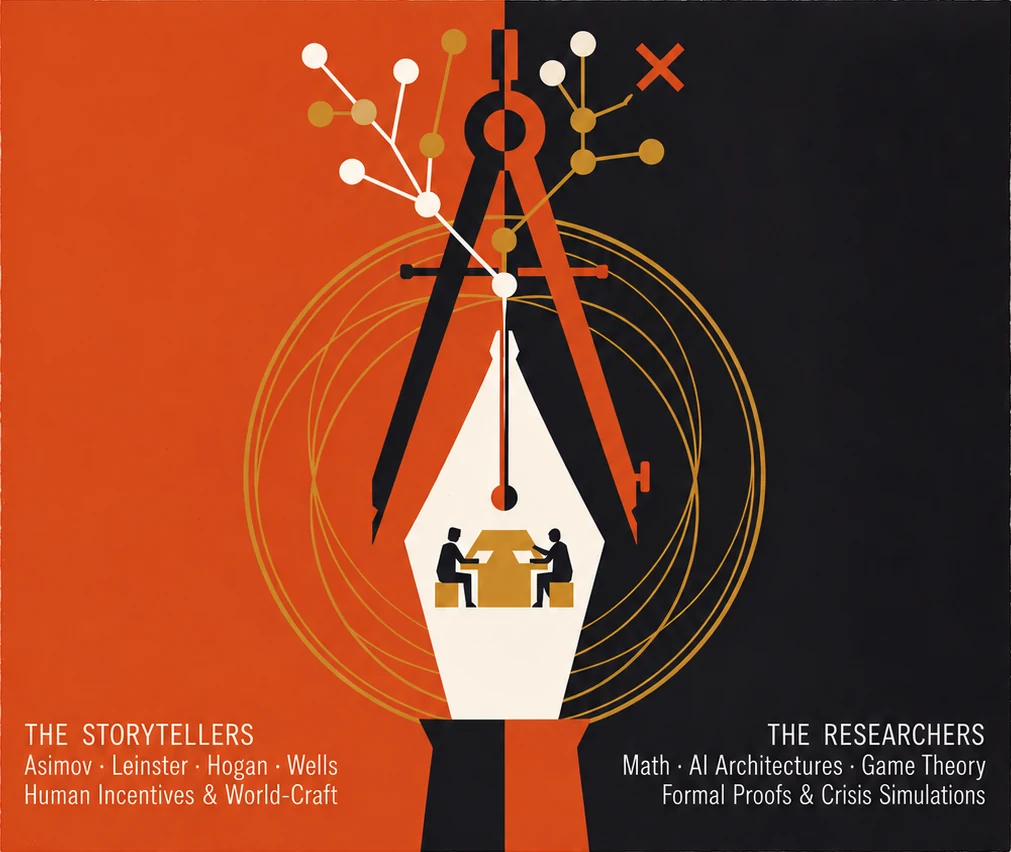
One book from each side, read with the other’s eyes.
Every session starts from a reading. Often that is a book, or a pair with one from each side: a novel and the paper, the memoir, the textbook chapter it leans on. It can equally be an essay, a technical report or a question the table has chosen to work through. A writer and a scientist open the conversation; everyone else at the table carries it. Dates are posted here and sent to members.
The WorldCon reading group
The boards, the reading and the dates, kept live and shared from the organisers' desk. This door always leads to it.
To be decided
The reading is chosen at the table and posted here once it is set.
The storytellers and the researchers.
Novelists, poets, essayists and screenwriters who work with science as material; scientists, mathematicians, philosophers and engineers who read fiction seriously and will say where it gets them wrong, and right; and readers who would rather hear both than either. The salon is a room, not a panel.
The future is outrunning the models we built to understand it.
The decades ahead will challenge us to reason about forces that are changing quickly and shaping one another: advances in AI, a changing climate, shifting institutions and political and technological upheaval. Mathematical models help us make these forces legible. They make assumptions explicit, reveal consequences and let us test ideas. But every model has a frame. The difficult question is not only what follows from its assumptions, but whether those assumptions leave out something that matters.
A larger model or a faster processor may help, but neither removes the need to question the frame itself. Fiction asks us to imagine what happens when people, institutions, technologies and accidents meet inside a world that has to hold together. It can surface possibilities and tensions that a particular model may not have considered. Call it the HPU beside the GPU: human imagination and judgment working alongside computational power.
The salon brings these ways of thinking into conversation. In discussion, tabletop exercises and futurist work, writers and scientists (and those in between) build scenarios together, challenge one another’s assumptions and examine what follows. Scientific discoveries and unanswered questions open new worlds and creative possibilities for fiction. In turn, fiction gives those ideas human and institutional context, and scientific reasoning tests their plausibility. Each can expose blind spots in the other.
A conversation about memory research might lead a writer to imagine a society where memories can be edited. Working through that world raises questions about identity, trust and evidence that the researchers had not thought to ask.
Our aim is not to predict the future with certainty or replace mathematics with storytelling. It is to inspire new stories, develop richer questions and better prepare for futures whose shape is still being decided.
A game played on a map of the literature.
Alongside the reading, the salon runs a tabletop exercise. Each player is a nation, a lab or a university in the years before the generative era, pushing research across a map drawn from the field itself, and nobody at the table knows where the decisive discovery lies.

Write to the organisers.
The salon is open to writers, scientists and readers by introduction. Send a line about what you read and what you do.